01
Challenge the status quo
A POV is an idea that makes prospects think differently about how to achieve their growth goals.
A POV is an idea that challenges the status quo so prospects think differently about how to grow. POV v1.2 diagnoses the target business as a living system with strengths and constraints, calibrates your effort to deal size, and turns your hypothesis into stress-tested outreach.
If the evidence is not strong enough, POV refuses to draft. It says NO POV YET and gives the next research actions.
Explore the whole process, or take it one step at a time.
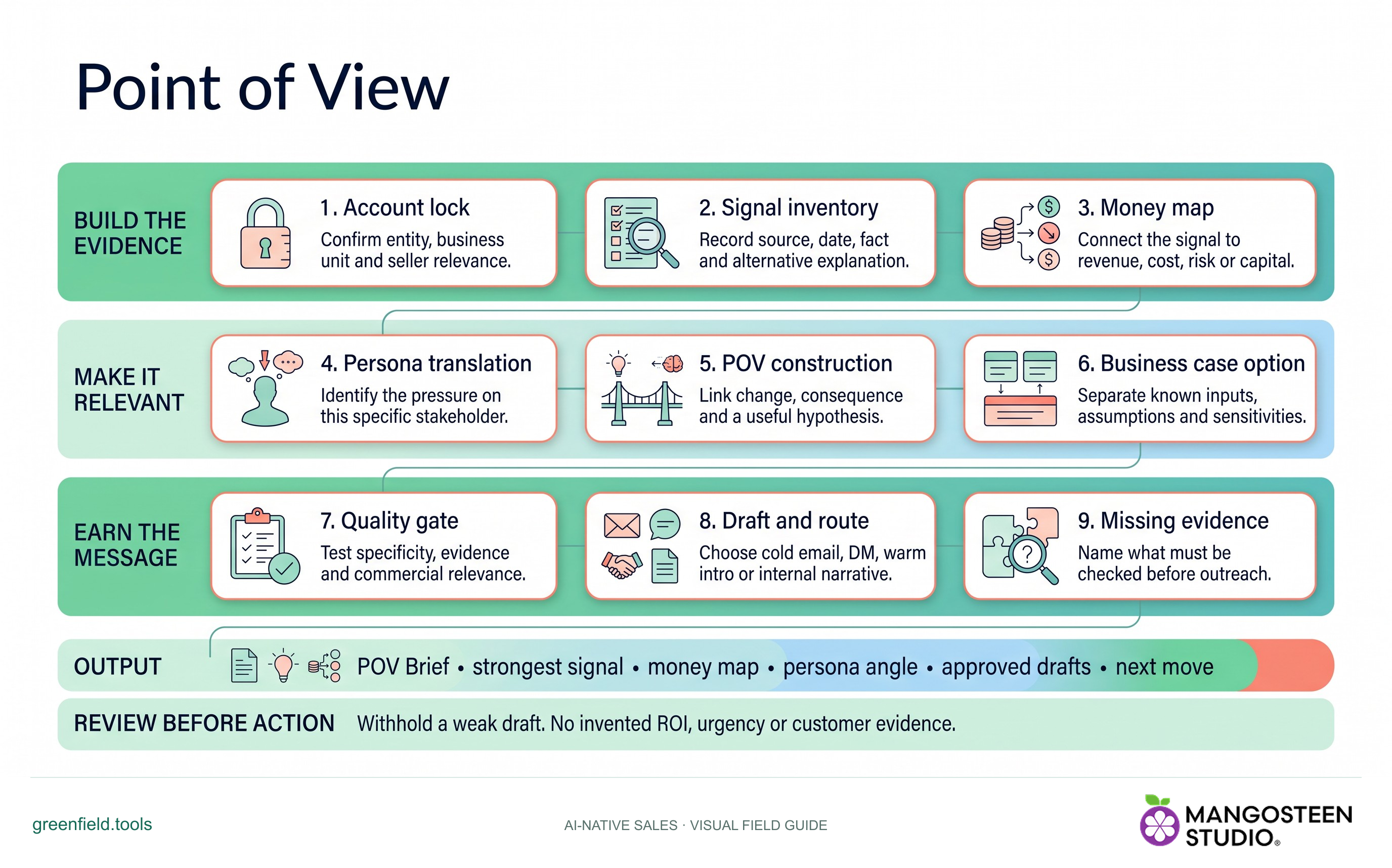
Confirm entity, business unit and seller relevance.
Record source, date, fact and alternative explanation.
Connect the signal to revenue, cost, risk or capital.
Identify the pressure on this specific stakeholder.
Link change, consequence and a useful hypothesis.
Separate known inputs, assumptions and sensitivities.
Test specificity, evidence and commercial relevance.
Choose cold email, DM, warm intro or internal narrative.
Name what must be checked before outreach.
Output: POV Brief • strongest signal • money map • persona angle • approved drafts • next move.
Withhold a weak draft. No invented ROI, urgency or customer evidence.
A POV is an idea that makes prospects think differently about how to achieve their growth goals.
Maps how pushing on one growth lever creates operational strain and constraints elsewhere in the business.
Matches depth to deal size: 60–120 minutes for a 7-figure logo, 15 minutes for a sprint, or 0 minutes (NO POV YET).
Shapes your cold emails, LinkedIn DMs, warm intros, and 14-day cadence to test the hypothesis in the market.
Pipeline, conversion, win rate, market entry.
Upsell, adoption, account penetration, usage.
Higher ACV, packaging, discount discipline.
Churn reduction, renewal risk, stickiness.
Automation, cost-to-serve, headcount leverage.
Compliance, security, downtime, vendor exposure.
Start with a real signal. Tie it to a money lever. Translate it for the person. Then draft the message.