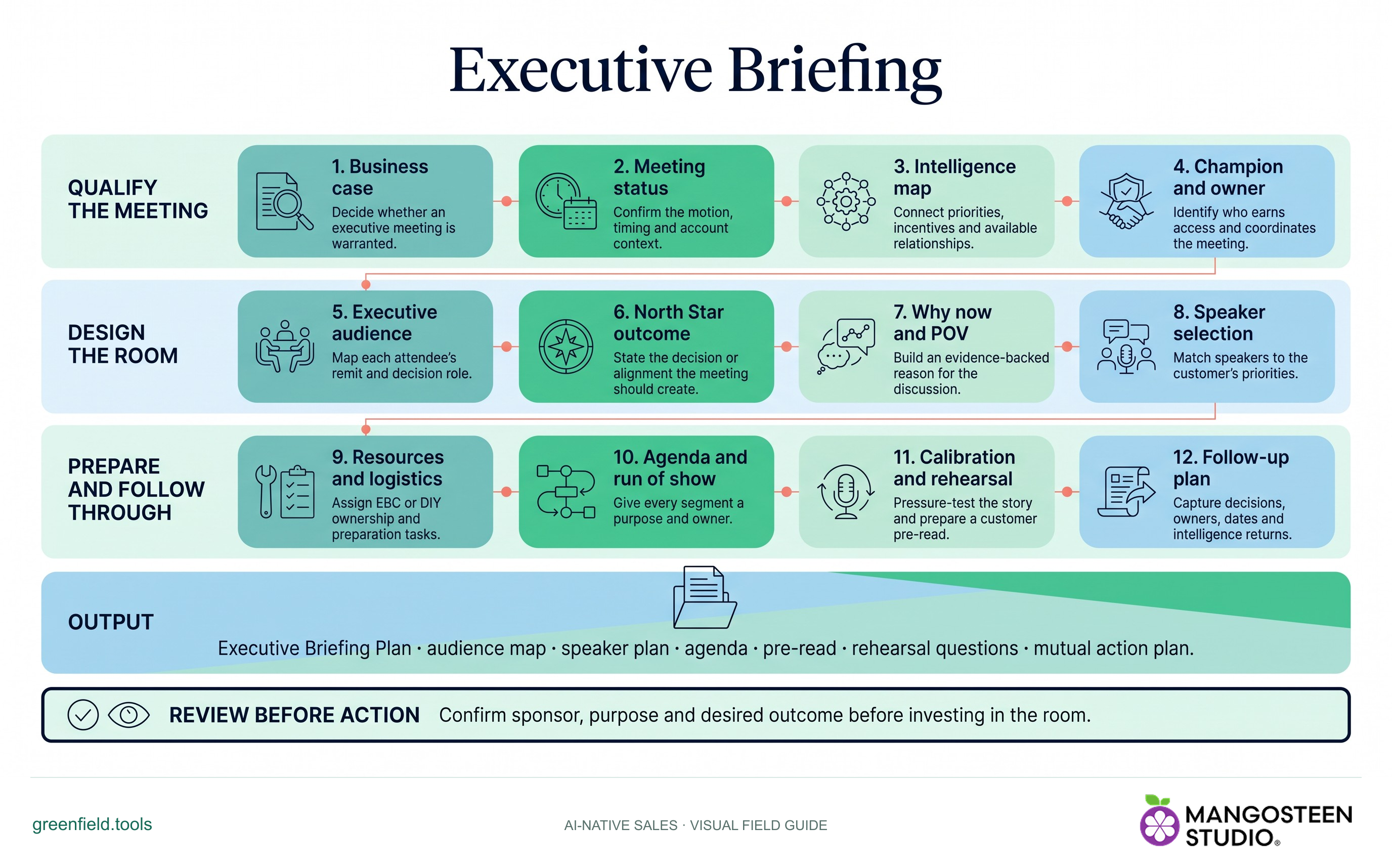
What is Executive Briefing?
Executive Briefing is a free AI skill for account executives who need to qualify, sell, plan, or run an executive briefing or executive demo. It turns a high-stakes executive meeting into a business outcome by building the business case, executive incentive map, audience map, common-connection graph, point of view, speaker calibration plan, agenda, customer pre-read, and follow-up artifacts.
Who is Executive Briefing built for?
It is built for AEs, enterprise sellers, sales leaders, founders, SEs, and customer-facing teams that need to make an executive meeting count. The primary user is the AE who owns the account and needs to sell the briefing internally, sell it to the customer, or prepare the team once the meeting is booked.
When should I use it?
Use it when you are trying to convince a customer to attend an executive briefing, when the briefing is already booked and you need to design the meeting, or when the better motion is a focused 30-60 minute executive demo. The skill starts by deciding which motion you are in and whether the briefing deserves scarce resources.
How is this different from Greenfield?
Greenfield helps you crack a new logo and find the way in. Executive Briefing starts when you have a path to an executive conversation and need to make the meeting worth the customer executive time. If you already ran Greenfield, you can paste the Account Brief into Executive Briefing and reuse the triggers, wedge, personas, and executive narrative.
Does the skill research my company resources too?
Yes, when the AI environment has search or browsing. If you work for a large or well-known company, the skill should search your seller company for executive briefing resources before assuming you are on your own. It looks for official pages and resources like executive briefing centers, customer briefing centers, briefing programs, innovation centers, field marketing support, and executive meeting teams.
How does it decide whether a briefing deserves EBC or executive resources?
It includes a business-case gate before agenda or resource planning. The skill scores commercial or strategic upside, customer executive access, why-now pressure, scarce-resource justification, and expected deal movement. If the score is weak, it recommends a smaller motion like an executive demo, workshop, dinner, discovery call, or champion working session instead of forcing a full briefing.
What if my company has an Executive Briefing Center?
If an Executive Briefing Center or formal briefing program exists, the skill switches into an EBC path. It helps you build the internal request for that team: account context, customer executives attending, North Star outcome, desired date range, speaker needs, narrative spine, and success metrics. It should use official company resources where available and mark anything unverified.
What if my company does not have an Executive Briefing Center?
If there is no EBC, the skill moves into a DIY path, but it does not turn the AE into an event planner. It separates the Strategic Host from the Operational Lead so the AE can stay focused on the customer relationship, room signals, and deal movement. For a smaller executive demo, it keeps coordination lightweight and focuses on technical prep, attendees, demo environment, and the narrative flow.
Does it research the customer executives?
Yes. The customer executive audience map goes deeper than name and title. In research-capable tools, the skill looks for official bios, LinkedIn profiles and posts, YouTube talks, podcast appearances, webinars, conference panels, earnings-call comments, investor-event quotes, interviews, and public writing. It extracts what each executive cares about, how they talk, their likely skepticism, what not to say, and which internal speaker style should match them.
Does it use annual reports, proxy statements, or DEF 14A filings?
Yes, when those sources are relevant and available. For public or strategic enterprise accounts, the skill asks the AI to review annual reports, 10-Ks, investor decks, earnings transcripts, and proxy or DEF 14A filings. The goal is to identify the board-level metrics and executive compensation signals that shape what the leadership team actually cares about.
Does it map warm paths into the executive team?
Yes. The skill builds a common-connection graph across internal leadership, board members, investors, advisors, former employers, alumni overlap, shared customers, partners, and credible mutual relationships. It does not assume a relationship exists just because two people overlap on paper; it marks those paths as verification actions until the AE confirms the relationship is real.
Why do YouTube videos, podcasts, and public talks matter?
Executive briefings work when the seller can speak to the executive world in the executive language. Videos, podcasts, panels, and interviews often reveal how an executive frames priorities, what words they use, what they are skeptical about, and what topics they return to. That can shape the opening point of view, speaker guidance, questions to ask, and what never to say in the room.
How does the skill prevent a generic agenda?
It has hard gates. It will not build an agenda until the North Star outcome is clear. It will not recommend speakers before the audience is mapped. Every agenda block must tie to the account, the customer executive audience, the North Star, or the executive point of view. Generic blocks like "welcome and introductions" are not enough unless the purpose is explicit.
What is the Murder Board Protocol?
For C-suite, strategic, high-ACV, or scarce-resource briefings, the skill prepares the team for the hardest questions before the meeting. It identifies the three most uncomfortable questions the customer could ask, the weak answers to avoid, and a stronger answer pattern that acknowledges the issue, answers directly, bridges back to the business outcome, and asks a calibrated question.
What does the skill produce?
It produces an Executive Briefing Plan: briefing snapshot, business case, North Star outcome, why-now trigger, enterprise intelligence, common-connection graph, customer executive audience map, champion or meeting-owner path, executive point of view, account team sync, speaker plan, pitch to sell the meeting, agenda and run of show, resource and role plan, Murder Board, customer pre-read, follow-up plan, risks, and intelligence gaps.
Does it work for executive demos?
Yes. Executive Demo mode is built in. If the account only warrants a 30-60 minute executive conversation, the skill creates a tighter narrative-led demo plan instead of forcing a half-day briefing. It still keeps the North Star, audience, point of view, proof points, demo flow, and follow-up plan.
Can it help sell the briefing before it is booked?
Yes. If the meeting is not booked, the skill builds the pitch for the briefing or demo. If you have a real champion, it creates a Champion Toolkit they can forward internally. If there is no champion, it avoids pretending one exists and builds a direct executive pitch instead.
What does Product or Engineering get out of attending?
The skill now requires an internal intelligence return when Product, Engineering, or senior SMEs are asked to participate. That can include product feedback, roadmap pressure, competitive intelligence, implementation risk, market language, or customer objections. This makes the meeting useful internally, not just a favor to Sales.
What makes the output trustworthy?
The skill uses Greenfield-style verification discipline. It separates verified facts, inferences, and unverified claims. It does not invent executives, titles, initiatives, EBC resources, quotes, venue details, or budget. If research access is limited, it gives the AE exact searches and internal questions to run manually.
What AI tools work best for Executive Briefing?
It works in web chat tools like ChatGPT, Claude, Gemini, and Grok because the markdown is self-contained. It works best in desktop or CLI tools with browsing or connected data, such as Claude Code, Codex, Cursor, Gemini CLI, and similar agents, because those tools can search public sources and sometimes inspect files, notes, or internal context directly.