First Call Deckseller contextsales slop detector5-7 slideshypothesis before productdiagnostic promptsproof before claimsmutual next stepFirst Call Deckseller contextsales slop detector5-7 slideshypothesis before productdiagnostic promptsproof before claimsmutual next step
The sales deck vocabulary for agents

Stop asking AI for
generic pitch decks.

First Call Deck is a free Greenfield Tools skill that teaches AI how to build and audit seller-grade first-call decks. It uses your SELLER.md, account context, proof, and buyer persona to create a short deck that earns discovery instead of dumping features.

The skill blocks sales slop: company-history openers, premature product screenshots, unsupported ROI, fake personalization, and weak "Any questions?" closes.

Visual field guide

See how the skill works.

Explore the whole process, or take it one step at a time.
Download PNG ↓
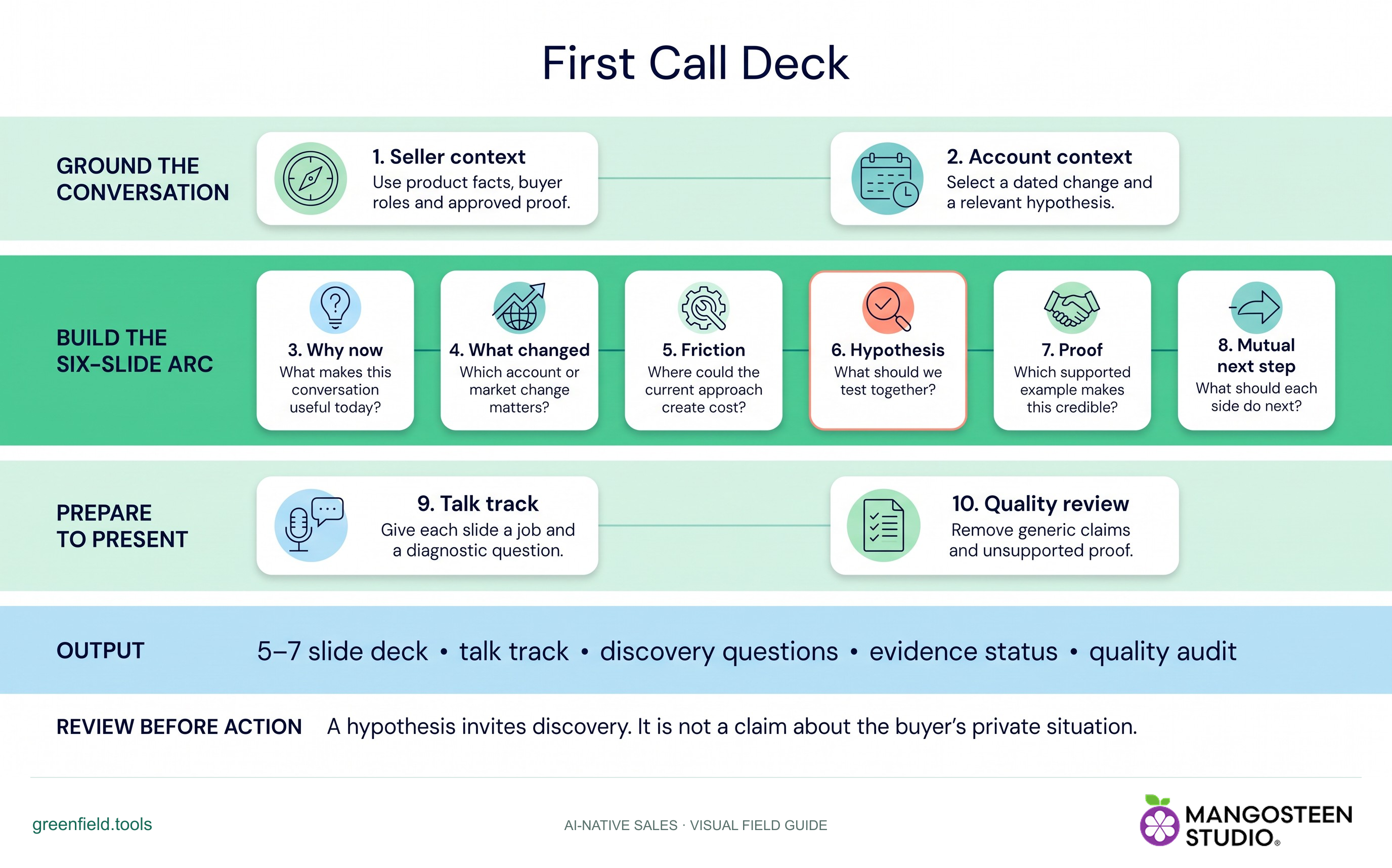
First Call Deck workflow diagram. All steps are available in the text guide below.
Read the complete step-by-step guide
  1. Seller context

    Use product facts, buyer roles and approved proof.

  2. Account context

    Select a dated change and a relevant hypothesis.

  3. 1 Why now

    What makes this conversation useful today?

  4. 2 What changed

    Which account or market change matters?

  5. 3 Friction

    Where could the current approach create cost?

  6. 4 Hypothesis

    What should we test together?

  7. 5 Proof

    Which supported example makes this credible?

  8. 6 Mutual next step

    What should each side do next?

  9. Talk track

    Give each slide a job and a diagnostic question.

  10. Quality review

    Remove generic claims and unsupported proof.

Output: 5–7 slide deck • talk track • discovery questions • evidence status • quality audit.

A hypothesis invites discovery. It is not a claim about the buyer’s private situation.

First Call Deck
First Call Deck full-size field guide

Scroll to inspect the image. Press Escape to close.

What it does

A first call is a conversation framework,
not a company brochure.

01

Seller context first

The agent reads what you sell, who you sell to, what you can prove, what you cannot say, and how you sound.

02

Account hypothesis

The deck opens with a credible reason for the meeting, not a company overview or generic category pitch.

03

Slide-level questions

Every slide gets a diagnostic prompt, so the seller creates a conversation instead of a monologue.

04

Slop audit

The skill flags feature dumping, unsupported ROI, fake personalization, generic claims, and weak closes.

First call deck template

The 6-slide first call deck template,
with a worked example.

This is the default slide arc the skill builds. Each slide has one job and one diagnostic question the seller asks while it is on screen. The example column uses a fictional account, Northfield Logistics, to show the level of specificity to aim for.

1. Why this conversation nowSlide job: Name the trigger that makes this meeting worth the buyer's time.
Example (fictional): Northfield opened two new regional hubs this year. Hub launches usually expose gaps in how dispatch and IT systems talk to each other.
Ask: What changed for your team when the new hubs went live?
2. What seems to be changingSlide job: Show what you believe is shifting in the account or market, tagged as verified or inferred.
Example (fictional): Inferred: more sites means more integrations owned by a small central IT team.
Ask: Is that the right read, or is the pressure coming from somewhere else?
3. The cost of the status quoSlide job: Describe the friction of doing nothing, with assumptions tagged instead of invented ROI.
Example (fictional): Assumption to test: each new hub adds manual reconciliation work before systems sync.
Ask: Where does that work land today, and who feels it first?
4. A hypothesis worth testingSlide job: Offer one specific, falsifiable idea, not a product pitch.
Example (fictional): If integration work is the bottleneck, the next hub launch is the moment to fix it, not after.
Ask: What would have to be true for that to be wrong?
5. Proof from a similar patternSlide job: Introduce product only now, through proof you can actually stand behind.
Example (fictional): A customer with a similar multi-site rollout pattern, described only with claims you are allowed to make.
Ask: Does that pattern look like your situation, or is yours different?
6. Mutual next stepSlide job: End with a concrete working session or decision path. Never "Any questions?"
Example (fictional): A 45-minute working session with dispatch and IT to map the next hub launch.
Ask: Who else needs to be in the room for that to be useful?
Command vocabulary

Give the agent precise seller direction,
not vague deck requests.

/firstcall

Build the first-call deck from seller and account context.

/audit-firstcall

Score an existing deck for sales slop and buyer relevance.

/unpitch

Strip broadcast selling language and turn slides into discovery.

/persona-lens CFO

Translate the same story for the stakeholder in the room.

/quantify-cost

Turn vague pain into a tagged cost-of-inaction model.

/advance

Replace weak closes with a concrete next step.

Sales slop detector

The skill checks the defaults
AI keeps reaching for.

About Us too earlyCompany history before the buyer problem is established.
Feature soupThree-column benefits or product grids with no business consequence.
Fake personalizationBuyer logo plus generic industry stats pretending to be research.
Unsupported ROISavings, impact, or risk claims without source status or assumptions.
Lazy closeEnding with "Any questions?" instead of a mutual next step.
FAQ

First-call deck questions,
answered simply.

What is First Call Deck?
First Call Deck is a free Greenfield Tools skill that helps account executives create and audit first-call sales decks. It uses SELLER.md, account context, proof, and buyer persona to build a 5-7 slide conversation framework instead of a generic pitch deck.
How is a first-call deck different from a pitch deck?
A pitch deck explains the seller. A first-call deck earns discovery. It should establish why the conversation matters, introduce a credible hypothesis, create buyer dialogue, and end with a mutual next step. It should not start with company history or a feature tour.
What is SELLER.md?
SELLER.md is the context file that teaches AI how you sell. It includes your product, ICP, personas, proof points, claims rules, competitors, objections, writing voice, and output quality bar. First Call Deck reads that context before creating sales material.
What does the sales slop detector check?
It flags the defaults AI often reaches for: About Us slides too early, feature grids, fake personalization, unsupported ROI, generic industry statistics, product screenshots before relevance is earned, and weak closes like Any questions?
What does one run produce?
A run produces the deck strategy, slide-by-slide outline, talk track, diagnostic questions, proof and assumptions table, what not to say, champion follow-up asset, sales slop audit, and next action checklist.
What should a first call deck template include?
Six slides: why this conversation now, what seems to be changing in the account, the cost of the status quo, a hypothesis worth testing together, proof from a similar customer or pattern, and a mutual next step. Each slide carries one diagnostic question for the seller to ask.
How many slides should a first call deck have?
Five to seven at most. The skill defaults to six and can cut to five with /tighten-to-5. Product should not appear until the buyer problem, trigger, or hypothesis is clear, which is usually slide five.
Is a discovery call deck the same as a first call deck?
They overlap. The skill has a Discovery mode that structures the conversation around gaps, impact, process, and next steps, alongside First Call, Demo Setup, Executive Overview, Champion Enablement, and Deck Audit modes.
Where does it fit with Greenfield and POV?
Greenfield finds the route into a cold account. POV turns evidence into a financially grounded narrative. First Call Deck turns that seller and account context into the actual first meeting asset, then audits it before the seller uses it.

Start with seller context.
Then make the deck.

Copy SELLER.md first. Then give the First Call Deck skill the account, persona, trigger, and proof. The result is a short deck designed to create a better first conversation.

First Call Deck page